TL;DR: Most organizations use AI mainly as a chatbot today, but the real shift is in how work and information move through an organization. After the digitization wave of the '90s/'00s and the process automation wave of the '10s, generative AI brings a third wave: systems that understand context, handle unstructured input, and can prepare work on their own. The interesting question isn't only what AI can take over, but how much of our work consists of operating systems in the first place.
Three waves of automation: from digitization to AI agents
Florian de Graaf · 2026-05-22 · 4 min read
AI is more than a chatbot
Many organizations still use AI mainly as a chatbot. Useful for generating texts, summaries, and ideas. But the real potential lies elsewhere: in redesigning how work and information move through organizations.
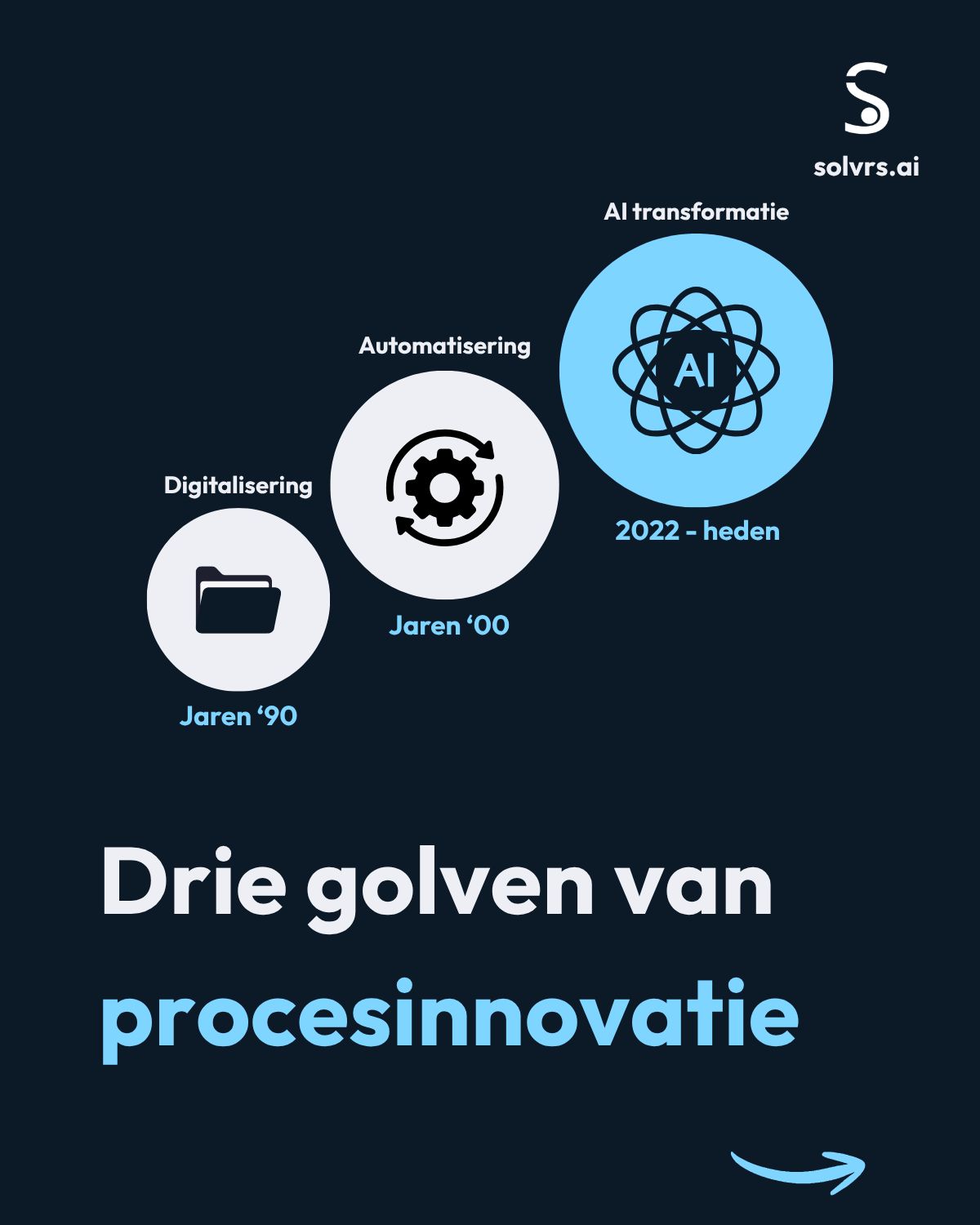
If you zoom out, you can roughly identify three adoption waves in information systems over the past decades.
Three waves of adoption
1. Digitization and system-building ('90s / 2000s)
Paper forms, scattered folders, and physical hand-offs gave way to ERP, CRM, and ticketing systems. Information was stored better, processes became measurable, and organizations could work faster.
2. Process automation (2010s)
Then integrations, workflows, APIs, and process automation were applied more broadly. Systems could execute fixed steps: if X happens, do Y. Valuable, but mostly in predictable processes with clear rules.
3. Generative AI transformation (from 2022)
Now the boundary is shifting again. AI can handle context, variation, and unstructured input.
- A customer request doesn't need to come in exactly the right format.
- A conversation doesn't have to follow a fixed script.
- An email doesn't first need to be manually translated into fields in a system.
An example: the account manager
Take an account manager who runs an onboarding call with a new client.
An AI agent can retrieve client information in advance, prepare the conversation, transcribe live during the call and surface key points, update the CRM, and queue up a follow-up email automatically.
The account manager doesn't disappear from the process, but their role shifts: less writing up, retyping, and administering across systems; more reviewing, correcting, and approving.
How is this different from classic automation?
It's no longer only about systems that store information or execute fixed rules. AI agents can interpret unstructured input, prepare work, and drive systems — with human oversight where it matters.
The interesting question
So the interesting question isn't only:
Which tasks can AI take over?
But more importantly:
How much of our work consists of operating systems, while adding little value in the process?
That's exactly where space opens up to redesign processes. Curious where that lives in your organization? Feel free to get in touch for a no-strings-attached conversation.